In crypto, centralised and decentralised structures describe who controls assets, transactions, and decision-making. Centralised platforms are operated by a company and may hold users’ crypto, while decentralised platforms allow users to trade or manage assets directly from their own wallets. [investor]
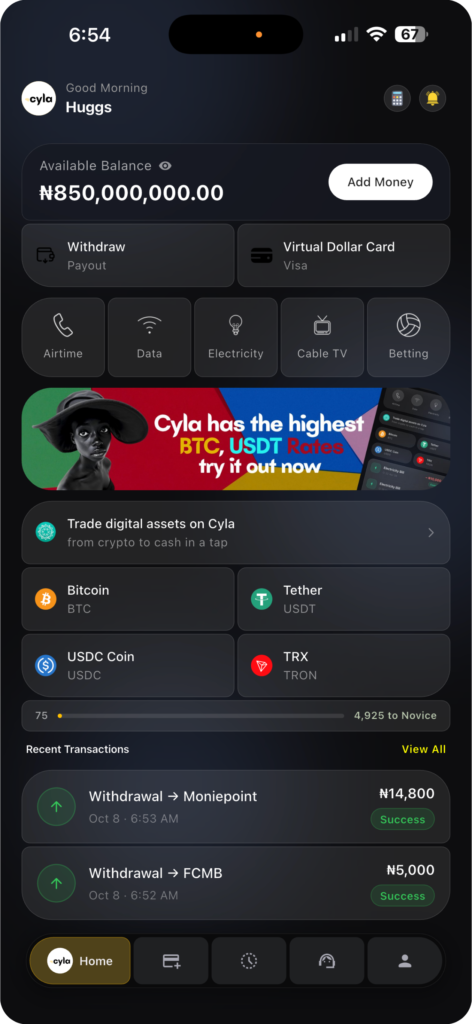
Centralised crypto structure
A centralised crypto structure is controlled by a company or platform. The platform manages user accounts, trading, security, withdrawals, and often the private keys that control deposited assets; this is known as third-party custody.
Examples include Binance, Coinbase, Kraken, KuCoin, and OKX. These apps are convenient because users can buy crypto with local currency, trade easily, access customer support, and use familiar interfaces.
Cyla.ng is also a centralised crypto service. It is a Nigerian crypto-to-naira app that lets users convert supported crypto into naira and receive payment in their bank account; it also offers features such as bill payments, airtime and data purchases, betting-account funding, and real-time exchange rates.
Benefits of centralised apps
- They are usually easier for beginners because the platform handles the technical process.
- They often provide customer support, account recovery options, and simple fiat-to-crypto services.
- They can offer fast crypto-to-naira conversion, as Cyla does for Nigerian users.
- They provide a single platform for trading, storing, converting, and paying bills.
Risks of centralised apps
- Users may not fully control their private keys because the platform holds or manages access to the assets.
- If the platform is hacked, shuts down, freezes an account, or becomes insolvent, users may lose access to their funds.
- Users depend on the company’s exchange rates, fees, rules, and withdrawal process.
Decentralised crypto structure
A decentralised crypto structure removes the need for one company to control users’ assets. Instead, users connect a self-custody wallet and approve transactions themselves through blockchain-based smart contracts.
Examples include Uniswap, PancakeSwap, Curve Finance, dYdX, and Jupiter. These platforms allow users to swap tokens, provide liquidity, or trade directly from wallets such as MetaMask, Trust Wallet, or Phantom.
Self-custody wallets such as MetaMask, Trust Wallet, Phantom, and Ledger Live are also decentralised tools because users keep control of their private keys. However, this also means users are fully responsible for protecting their recovery phrase and avoiding scams.
Benefits of decentralised apps
- Users keep control of their private keys and assets.
- Transactions can happen without relying on a company’s approval or account restrictions.
- Users can access decentralised finance, token swaps, and Web3 applications.
- There is no need to trust a single exchange with custody of all assets.
Risks of decentralised apps
- If a user loses their seed phrase or private key, they may permanently lose access to their crypto.
- Users can fall victim to fake tokens, malicious smart contracts, phishing links, or wrong wallet approvals.
- There is usually no customer-support team that can reverse a mistaken blockchain transaction.
Cyla vs decentralised apps
| Feature | Cyla.ng | Decentralised apps |
|---|---|---|
| Type | Centralised crypto-to-naira service. | Decentralised exchange or self-custody wallet. |
| Main purpose | Convert crypto to naira and settle it in a bank account. | Swap, trade, or manage crypto directly from a wallet. |
| Asset control | The platform manages the conversion and settlement process. | Users control their private keys and approve transactions. |
| Best for | Nigerians who want quick crypto-to-cash conversion. | Users who value self-custody and direct blockchain access. |
| Examples | Cyla.ng. | Uniswap, PancakeSwap, MetaMask, Trust Wallet. |
Which should users choose?
Users should choose based on their goal. A centralised service such as Cyla.ng is useful for converting crypto into naira quickly and paying bills, while decentralised apps such as Uniswap or Trust Wallet are better for users who want direct control of their assets.
A practical approach is to use a centralised platform for buying, selling, or converting crypto when convenience matters, then move long-term holdings into a self-custody wallet if the user understands how to protect their recovery phrase. Self-custody gives users control, but it also transfers responsibility for security entirely to them.